
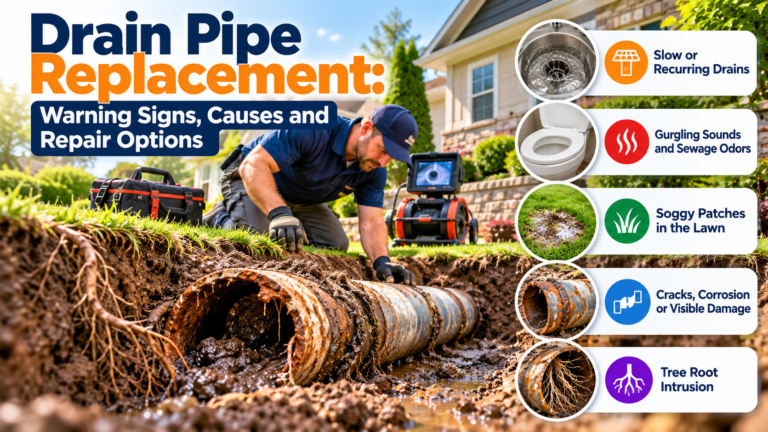
Drain pipes fail the way most things underground fail: slowly, invisibly, and then all at once. A pipe that’s been quietly deteriorating for years doesn’t usually announce itself until a backup, a sinkhole in the yard, or a sewage smell that won’t go away. By then, the question isn’t whether something needs attention; it’s how much needs to be done and what it’s going to take to fix it.
Here’s what actually causes drain pipes to fail, the warning signs worth paying attention to before it gets to that point, and the range of repair options available depending on how bad the damage actually is.
What Are the Common Signs That a Drain Pipe Needs Replacement?
A few patterns consistently show up before a full failure.
Slow or recurring drains across multiple fixtures, not just one, often point to a problem in the main line rather than an isolated clog. Gurgling sounds from drains or toilets, especially when another fixture is running, suggest air is getting trapped somewhere it shouldn’t be, usually a sign of partial blockage or a vent issue tied to pipe damage. Sewage odors inside or outside the home, particularly near where the line runs, are one of the more unmistakable signs something’s actually broken rather than just clogged. Unusually lush or soggy patches of lawn above the pipe’s path can mean sewage is leaking into the soil and acting as fertilizer, not a good sign, however green the grass looks. Visible cracks, sagging, or corrosion on any exposed section of pipe is a direct sign of deterioration. And a sudden increase in pest activity, particularly rodents or insects near drains, sometimes traces back to a crack providing an entry point.
Any one of these in isolation might be minor. Several showing up together, or recurring after a cleaning, usually means the problem is structural rather than something a simple cleaning will fix long-term.
What Causes Residential Drain Pipes to Deteriorate?
A handful of mechanisms are responsible for the overwhelming majority of drain pipe failures.
Aging materials. Clay pipe becomes brittle with age, and cast iron corrodes steadily when exposed to moisture and the chemical makeup of household waste over decades. Older materials simply don’t hold up the way modern PVC does.
Ground movement. Soil expands after heavy rain and contracts during dry spells, and that constant shifting stresses pipe joints over time. Vibration from nearby traffic or construction accelerates the same effect, gradually cracking pipe or separating joints that were originally sealed tight.
Tree root intrusion. Roots seek out moisture and will exploit any small crack or loose joint to get to it. Once inside, they keep growing, widening the original damage and eventually blocking the line entirely.
Poor original installation. Incorrect pipe gradient, weak or poorly sealed joints, low-quality materials, or inadequate bedding in the ground all leave a pipe more vulnerable to every other cause on this list. A pipe installed correctly in the first place tends to resist the other factors far longer.
Persistent blockages. Grease, debris, and buildup don’t just slow water flow; they increase internal pressure in the pipe, which over time can strain joints and contribute to cracking.
Most failures aren’t caused by just one of these. A pipe with a decades-old joint weakened by ground movement is far more vulnerable to root intrusion than a newer, properly installed one, which is part of why older homes tend to have more frequent and more serious drain pipe problems than newer construction.
When Is Drain Pipe Replacement Better Than Repairing the Pipe?
The honest answer depends entirely on what a camera inspection actually shows, but a few patterns generally point toward replacement rather than repair.
If damage is isolated to one short section and the rest of the line is structurally sound, spot repair usually makes sense, it fixes the specific problem area and leaves everything else undisturbed, at the lowest cost of any option. If the pipe has several worn or cracked spots along a longer run but hasn’t lost its shape, trenchless lining (CIPP) is often the better fit, sealing the interior of an extended section from the inside without major digging. But if a pipe has collapsed, sagged significantly, or corroded to the point of losing its structural shape, lining won’t work. A liner can’t fix a pipe that no longer holds its form; at that point, pipe bursting or full replacement becomes the only real option, pulling a new pipe through the old one’s path.
As a general rule: the more extensive and structural the damage, the more a repair stops being cost-effective compared to replacement. Patching a severely deteriorated line repeatedly tends to cost more over time, and with more disruption, than addressing it properly once.
How Long Does a Typical Residential Drain Pipe Replacement Take?
For a standard trenchless replacement (pipe bursting or lining), most residential projects take 1 to 3 days once the crew is on site, since these methods avoid digging a full trench the length of the pipe. Traditional dig-and-replace, which requires excavating a trench to access the damaged line, generally takes longer, often 2 to 5 days depending on the length of run and how much landscape restoration is needed afterward.
The timeline before work even starts matters too: scheduling a camera inspection, getting an accurate diagnosis of what repair method actually applies, and obtaining any required permits can add another week or more on top of the physical work itself.
Can Regular Sewer Cleaning Help Prevent Drain Pipe Problems?
Yes, meaningfully. Routine sewer cleaning, typically every 18-24 months for most homes (annually for older pipe materials or homes with mature trees nearby), clears the grease and debris buildup that contributes to internal pressure and strain on pipe walls. It also catches early-stage root intrusion before roots have a chance to cause real structural damage, and a camera inspection during a routine cleaning often spots a developing crack or joint separation long before it becomes a full backup.
Cleaning can’t fix structural damage that’s already occurred, and it won’t un-crack a pipe or reverse corrosion. But as prevention, it’s one of the most cost-effective things a homeowner can do to catch problems while they’re still a $200 cleaning instead of a multi-thousand-dollar replacement.
Frequently Asked Questions
What are the common signs that a drain pipe needs replacement?
Recurring slow drains across multiple fixtures, gurgling sounds, sewage odors, unusually lush or soggy patches of lawn above the pipe’s path, visible cracks or corrosion on exposed pipe, and increased pest activity near drains. Several of these appearing together usually points to a structural problem rather than a simple clog.
What causes residential drain pipes to deteriorate?
Aging materials (brittle clay, corroding cast iron), ground movement from soil expansion and contraction, tree root intrusion through existing cracks, poor original installation, and persistent blockages that stress pipe walls over time. Most failures involve more than one of these factors working together.
When is drain pipe replacement better than repairing the pipe?
Spot repair works for one isolated section with the rest of the line intact. Trenchless lining works for several worn spots on a pipe that still holds its shape. Once a pipe has collapsed, sagged, or lost its structural shape, repair methods like lining no longer apply, and replacement (often via pipe bursting) becomes the only real option.
How long does a typical residential drain pipe replacement take?
Trenchless methods usually take 1-3 days once work begins. Traditional dig-and-replace typically takes 2-5 days. Scheduling, inspection, and permitting beforehand can add another week or more to the overall timeline.
Can regular sewer cleaning help prevent drain pipe problems?
Yes. Routine cleaning every 18-24 months (annually for older pipes or homes with mature trees) clears buildup that stresses pipe walls and catches early root intrusion or developing cracks before they become structural failures. It’s prevention, not a fix for damage that’s already occurred.