
A clogged drain feels like a small, annoying problem right up until it isn’t. Water backing up into a tub. A gurgling sound from the toilet every time the washing machine drains. A sewage smell that comes and goes in the basement. Individually, these look like minor nuisances. Together, they’re usually a sewer line trying to tell you something, and ignoring that message is how a $200 cleaning turns into a $9,000 pipe replacement.
Regular sewer cleaning services are one of those unglamorous maintenance items that never feel urgent until the day they very much are. Here’s how they actually prevent bigger problems, and what to do when it’s too late for prevention and you’re staring down an emergency instead.
What’s Actually Happening Inside Your Sewer Line
Every home’s main sewer line slowly accumulates buildup over time: grease, soap scum, mineral deposits, and whatever shouldn’t have gone down a drain in the first place. On top of that, tree roots are one of the most common causes of sewer line damage, working their way into tiny cracks in search of moisture and eventually choking off the flow entirely. Older pipe materials, clay, cast iron, Orangeburg, make this worse, since they’re more prone to cracking and corrosion than the PVC used in newer construction.
None of this happens overnight. It builds for months or years, which is exactly why routine drain cleaning services work so well as prevention: they clear the buildup before it narrows the pipe enough to cause an actual backup.
How Often Should Sewer Lines Be Cleaned?
For a typical household with normal water usage and no major tree coverage near the line, every 18 to 24 months is the standard recommendation. Two situations call for something more aggressive:
Homes with mature trees near the sewer line should move to annual cleaning. Root intrusion is progressive, once roots find their way in, they keep growing, and an annual hydro jetting schedule keeps them from taking over the pipe between visits.
Older homes, particularly anything built before 1980 with clay, cast iron, or Orangeburg pipe, should also default to annual service. Those materials simply don’t hold up the way modern PVC does, and the buildup that would take years to matter in a newer pipe can become a real problem much faster in an older one.
If you don’t know when your sewer line was last cleaned, that uncertainty alone is worth a call. A camera inspection (typically -400) will tell you exactly what’s going on before you commit to anything more.
What’s Included in a Professional Drain Cleaning Service?
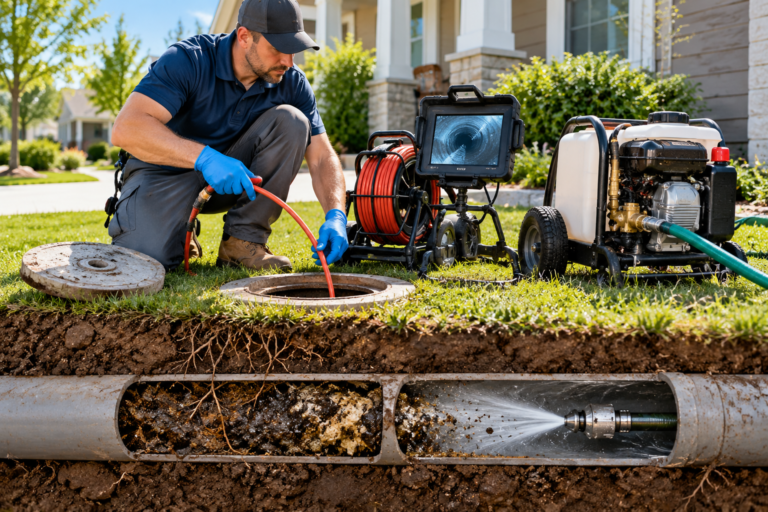
A proper service goes well beyond running a snake through the nearest drain. It typically starts with a camera inspection to actually see what’s inside the pipe, root intrusion, buildup, cracks, bellies in the line where waste collects. From there, most professional drain cleaning services use hydro jetting: high-pressure water that scours the inside of the pipe clean, rather than just punching a hole through a clog the way a basic snake does.
Snaking still has its place for a simple, isolated clog close to the surface. But for a main sewer line with years of accumulated grease and root growth, hydro jetting gets results that last substantially longer, since it clears the entire diameter of the pipe rather than just carving a path through the middle.
A thorough service should end with another camera pass to confirm the line is actually clear, plus a clear explanation of what the technician found and whether anything (root damage, a crack, a collapsed section) suggests repair or replacement is coming sooner rather than later.
What Should I Avoid Doing During a Drain Emergency?
A few instinctive reactions actually make things worse.
Don’t keep running water or flushing, hoping it’ll push the clog through. With a main line backup, that just adds more water with nowhere to go, increasing the odds of it backing up into a tub, shower, or floor drain instead.
Don’t dump chemical drain cleaner down the line hoping to dissolve a sewer clog. Those products are designed for simple fixture clogs, not a main line blockage, and using them repeatedly can damage older pipes, which is the opposite of what you want right before calling someone to inspect those same pipes.
Don’t ignore multiple fixtures backing up at once. A single slow drain might be a local clog. Several fixtures backing up together, especially the lowest drain in the house, is a strong sign of a main line problem and should be treated as more urgent.
And don’t wait to call, hoping it resolves on its own. Sewage backup is a health hazard, and the longer it sits, the more it can affect flooring, drywall, and anything else it reaches.
Do You Offer Emergency Drain Service Outside Business Hours?
Most established sewer and drain companies offer 24-hour emergency service for exactly this reason — sewage backups and complete blockages don’t wait for business hours, and a backup left untreated overnight can cause significantly more damage than one addressed immediately. When evaluating an emergency drain service, confirm upfront whether someone actually answers after hours (plenty of companies route calls to voicemail despite advertising 24/7 availability) and ask what their typical response time looks like for an active backup versus a routine appointment.
How Much Does Drain Pipe Replacement Cost?
When cleaning and repair are no longer enough, a collapsed section, extensive root damage, pipe that’s simply too deteriorated to patch, replacement becomes the next step. Costs vary by method:
Method | Cost per Linear Foot | Notes |
Traditional dig-and-replace | $50 – $250 | Requires trenching; adds 12/ft in labor |
Trenchless pipe bursting | $60 – $200 | Breaks old pipe, pulls new line through |
Trenchless CIPP lining | $80 – $250 | Epoxy liner pulled through existing pipe; ~$9,000 average project |
Trenchless methods generally cost more per foot but save significantly on yard restoration, since traditional replacement requires digging a full trench the length of the damaged line. Additional costs to budget for include a camera inspection (-400), project cleanup (-10,000 depending on scope), and landscape restoration (-10,000) if trenching was required. A written estimate following a camera inspection is the only reliable way to know which approach, and which price range, applies to your specific situation.
Frequently Asked Questions
How often should sewer lines be cleaned?
Every 18 to 24 months for a typical home. Homes with mature trees near the sewer line or older pipe materials (clay, cast iron, Orangeburg, generally pre-1980) should move to annual cleaning instead.
What should I avoid doing during a drain emergency?
Don’t keep running water or flushing hoping the clog clears itself, don’t pour chemical drain cleaner down a main line blockage, don’t ignore multiple fixtures backing up at once, and don’t wait to call, sewage backup gets worse and more damaging the longer it sits untreated.
What’s included in a professional drain cleaning service?
A camera inspection to see what’s actually happening inside the pipe, hydro jetting to clear buildup and root intrusion from the full diameter of the line (rather than just punching through a clog), a follow-up camera check to confirm the line is clear, and a clear explanation of the findings.
Do you offer emergency drain service outside business hours?
Most established sewer and drain companies offer 24-hour emergency service, since backups don’t wait for convenient timing. Confirm in advance that a real person answers after hours and ask about typical response time for an active emergency.
How much does drain pipe replacement cost?
Traditional dig-and-replace runs -250 per linear foot. Trenchless pipe bursting runs 200 per foot, and trenchless CIPP lining runs -250 per foot (often around $9,000 for a typical project). Camera inspection, cleanup, and landscape restoration are usually separate costs on top of the pipe work itself.